

FAQs about the Paris Catacombs
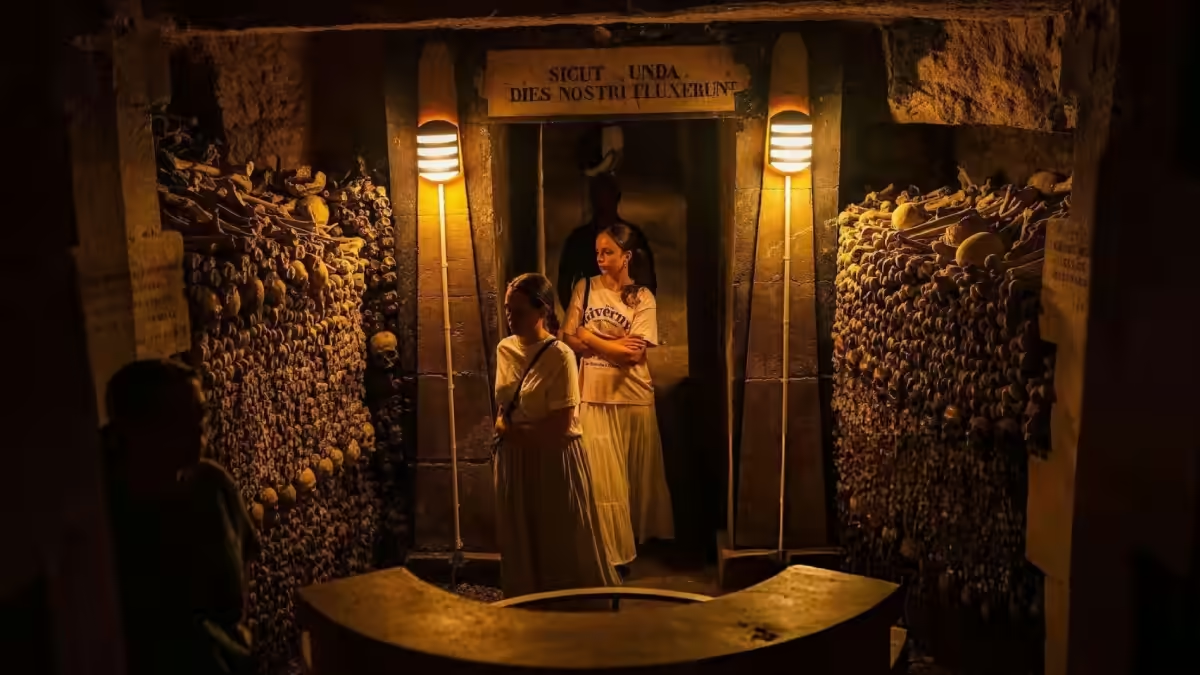
The Paris Catacombs cost €31 for adults with the audio guide included, open Tuesday to Sunday 9:45am–8:30pm (closed Mondays), and the visit involves 131 steps down and 112 up with no lift. Tickets are online-only, released seven days ahead, and the Paris Museum Pass isn’t valid. The site reopened on 8 April 2026 after a major renovation.
This page collects the questions we’re asked most often about visiting the Paris Catacombs, grouped by topic so you can jump straight to what you need. If you want the fuller version of any answer, each section links through to a dedicated guide.
Between tickets, timing, the physical demands of the route and the site’s history, there’s more to plan for here than most Paris attractions — so treat this as the quick-reference version of everything else on the site.
How much does a Paris Catacombs ticket cost?
The official adult ticket (27+) is €31, including the audio guide. Reduced tickets for ages 18–26 and students are €25, also with audio guide included; children aged 5–17 pay around €12, with the audio guide as an optional €5 extra. Under-5s go free, as does a disabled visitor and one carer. Our ticket and audio guide guide breaks down every option.
Is the Paris Museum Pass valid at the Catacombs?
No. The Paris Museum Pass is not accepted at the Catacombs, unlike most other major Paris museums and monuments. You’ll need a dedicated, timed ticket regardless of any pass you’re carrying. Our guide to the Paris Museum Pass and the Catacombs explains exactly what the pass does and doesn’t cover, so you’re not caught out at the door.
How far ahead can I book tickets?
Official tickets are sold online only, at billetterie-parismusees.paris.fr, and released seven days ahead at 10am Paris time. They sell out within hours in peak season, so booking the moment a slot opens — or using a reseller ticket with more flexible dates — is the reliable approach. See how to book Paris Catacombs tickets for the full process.
Are there any discounts or free entry?
Under-5s always go free, as does one carer accompanying a disabled visitor. Ages 18–26 and students qualify for the reduced €25 rate, and children 5–17 pay around €12. There’s no general discount for the Paris Museum Pass or most city tourist cards. Our guide to free entry and discounts covers every eligible group.
What’s the difference between the official ticket and a reseller ticket?
The official ticket is cheaper but online-only, released just seven days ahead and prone to selling out. Reseller tickets, such as the entry ticket with audio guide, cost a little more but often open up further-ahead dates. Both include timed entry and an audio guide; the choice comes down to how far ahead you’re planning.
What are the Paris Catacombs opening hours?
The Catacombs are open Tuesday to Sunday, 9:45am to 8:30pm, with last admission at 7:30pm. They’re closed every Monday, plus 1 January, 1 May and 25 December. See our full opening hours guide for how this affects booking a slot around the rest of your trip.
Are the Catacombs open on Mondays?
No. The Catacombs are closed every Monday, year-round, alongside three public holidays. If Monday is your only spare day in Paris, plan other sights for it and book your Catacombs slot for a different day — tickets are timed and online-only, so you can’t simply turn up when the doors happen to be open.
What time is last admission?
Last admission is 7:30pm, a full hour before the 8:30pm closing time, to allow everyone time to complete the roughly hour-long underground route and climb the exit stairs before the site shuts. Arrive at your booked slot, not at the closing time — entry is strictly timed and the site doesn’t admit walk-ups after 7:30pm.
What’s the nearest metro station?
Denfert-Rochereau, served by métro lines 4 and 6 and RER B, sits about 50 metres from the entrance on place Denfert-Rochereau. It’s one of the easier attractions in Paris to reach by public transport. Our guide to how to get to the Paris Catacombs covers routes from other parts of the city too.
Where exactly is the entrance?
The entrance is at 1 Avenue du Colonel Henri Rol-Tanguy, on place Denfert-Rochereau in the 14th arrondissement, beside the Lion of Belfort statue. It’s a small, easy-to-miss pavilion rather than a grand building, so look for the queue and signage rather than an obvious monument.
Is the exit in the same place as the entrance?
No. You enter at Denfert-Rochereau and exit at a separate address, 21bis Avenue René-Coty, roughly a ten-minute walk away at street level. There’s no route back to the entrance underground, so plan on finishing your visit somewhere different from where you started. Our map and visitor route guide walks through the whole path in order.
How long does the visit take?
Plan for about 45 minutes to an hour underground, covering roughly 1.5km of tunnels and the ossuary itself, plus the 131 steps down and 112 up. Add time either side for security checks and getting to and from the entrance and exit. It isn’t a rushed visit, but there’s also no bench-lined route for a long rest along the way.
How many steps are there, and is there a lift?
There are 131 steps down at the start and 112 steps up at the exit — 243 in total — with no lift at either point. The descent is a tight spiral staircase; the exit climb is more open but still demanding. Anyone with mobility, breathing or heart conditions should weigh this carefully; see our accessibility guide for more detail.
How deep underground do you go, and how long is the route?
The Catacombs sit about 20 metres below street level — roughly the height of a five-storey building — and the visitor route covers about 1.5km from the entrance staircase to the exit stairs. Most of that distance runs through the quarry galleries before you reach the ossuary itself, which sits towards the end of the walk.
What’s the temperature like underground, and what should I wear?
It’s a constant 14°C year-round, regardless of the season above ground, and can feel damp. A jumper or light jacket makes a real difference even in summer, and flat, comfortable shoes matter more than usual given the stairs and uneven quarry floors. Our guide on what to wear and bring has the full packing list.
Is the Paris Catacombs wheelchair accessible?
No. The only way in and out is via the 131-step and 112-step staircases, with no lift or ramp, so the site cannot accommodate wheelchair users or anyone unable to manage stairs. This didn’t change with the 2026 renovation, though some accessibility improvements were made for visitors with visual and hearing impairments. See our accessibility guide for the full picture.
Is the Paris Catacombs scary?
Not in a jump-scare sense — it’s atmospheric and sombre rather than staged as a horror experience, with dim lighting and a respectful, reflective tone throughout. What some visitors find unsettling is the sheer scale of the bone walls and the enclosed, cool tunnels rather than anything theatrical. Our dedicated guide on whether the Catacombs are scary covers this in full.
Is it suitable for young children?
It’s generally not recommended for very young children, roughly under 4–5, due to the stairs, the cold, the length of the walk and the subject matter. Older children who understand what they’re seeing usually manage fine and often find it fascinating rather than frightening. Our guide to visiting with kids has age-by-age advice.
Is it suitable for people with claustrophobia?
It can be a difficult visit for people with claustrophobia — the tunnels are narrow in places, the route is one-way with no shortcuts, and the descent staircase is tight and enclosed. Staff are positioned along the way if you need help, but there’s no quick exit partway through. It’s worth reading in advance if you’re unsure how you’ll react.
What are the rules once you’re inside?
No large bags or luggage (there’s no left-luggage facility), no touching or taking bones, no flash photography or tripods, and no food or drink. Noise should stay respectful throughout, given the site’s nature as a working tomb. Our rules and etiquette guide covers everything to know before you go.
How many people are buried in the Paris Catacombs?
The ossuary holds the remains of around six million Parisians, moved here from the city’s overflowing cemeteries — most notably the Saints-Innocents — starting in 1786. The bones were later arranged into the wall patterns seen today from 1809, under Inspector General Louis-Étienne Héricart de Thury. Our history guide covers the full story from Roman quarry to modern attraction.
When did the Catacombs become an ossuary?
Bones began arriving in 1786, as Paris’s cemeteries — above all Saints-Innocents — were closed and cleared for public health reasons, with remains transferred into the disused limestone quarries beneath the city. It wasn’t until 1809 that the bones were formally arranged into the decorative walls visitors see today. See the ossuary for how that arrangement works.
When did the Catacombs reopen after the renovation, and what changed?
The Catacombs closed for a major safety and preservation renovation and reopened on 8 April 2026, with a new visitor route, a new multilingual audio guide, improved lighting, new air-handling and climate control, and modernised fire-safety systems. Our 2026 renovation guide covers every change in detail, and is the Catacombs worth visiting weighs up the post-renovation experience.
Are the Catacombs the same tunnels used by cataphiles?
Only in part. The official Catacombs occupy a small, managed section of a much larger network of former quarry tunnels — around 200–300km in total — that runs beneath much of the Left Bank. Cataphiles enter the wider, off-limits network illegally through hidden access points; the official visitor route is entirely separate and legal. Our guide to cataphiles explains the distinction.
