

The Catacombs in popular culture
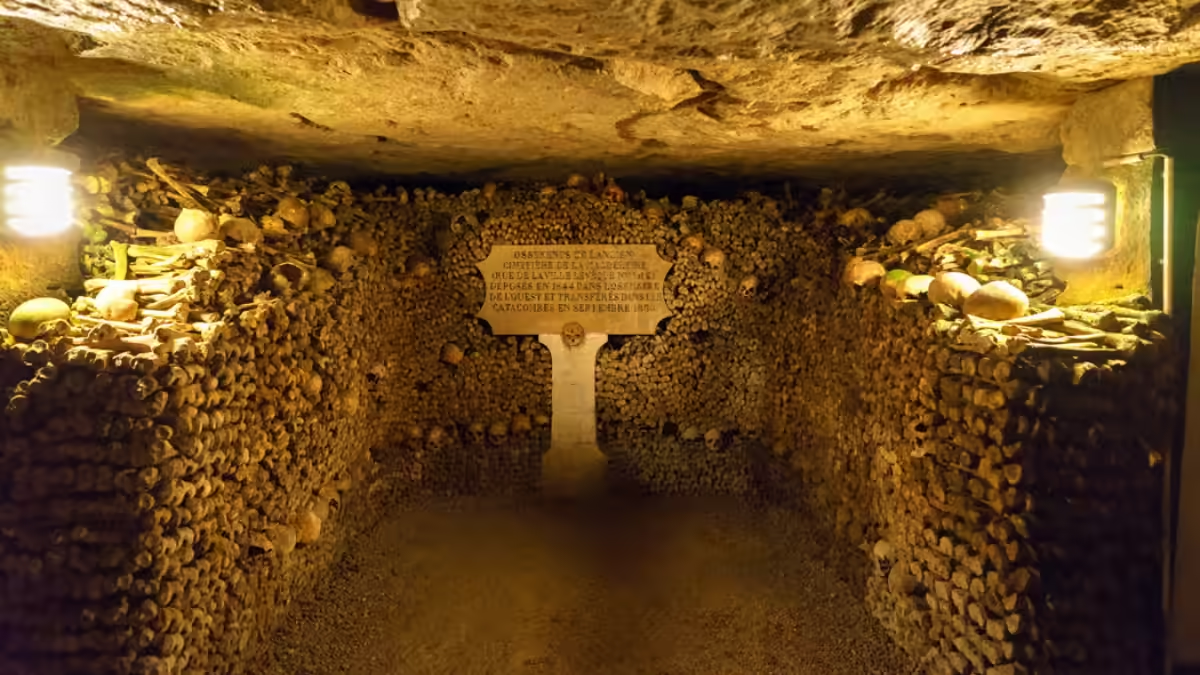
The Paris Catacombs have inspired films, novels, music and video games for decades, feeding the city’s reputation as a place where history and the macabre meet. The best-known example is the 2014 found-footage horror film “As Above, So Below”, shot partly inside the real tunnels with official permission. In 2024, Queens of the Stone Age became the first band permitted to perform live there. The site’s genuine eeriness, rather than invented myth, is usually what draws creators back.
Few attractions anywhere blend real history with horror-film atmosphere as naturally as the Catacombs. A tomb holding the remains of some six million people, reached down 131 steps into cold, dim tunnels, was always going to end up on screen and on the page — and it has, repeatedly, for over a century of popular imagination.
This guide covers the films, music, books and games that have used the Catacombs as a setting, and why the real site keeps proving more compelling than anything invented about it.
As Above, So Below: the film made inside the real Catacombs
“As Above, So Below” (2014) follows an archaeologist searching the Catacombs for the legendary philosopher’s stone, only for her documentary crew to descend into a nightmare loosely modelled on Dante’s nine circles of Hell. It was reportedly the first film granted permission to shoot inside the actual Catacombs and quarry network, including restricted sections, over a gruelling five-week underground shoot. Made on a budget of around $5–10 million, it earned roughly $41.8 million worldwide.
The found-footage horror film leans heavily on the tunnels’ real disorientating scale rather than studio sets, which is a large part of why it’s still cited as the definitive Catacombs film. Crews worked without electricity or phone signal in places, with actors lighting scenes using their own headlamps in the cold and damp. Reviews on release were mixed, but the film built a lasting cult following after landing on streaming platforms in the years since. The ossuary itself — walls of stacked skulls and femurs — is what most of the film’s imagery draws directly from.
A rival take: Catacombs (2007)
A separate horror-thriller, simply titled “Catacombs” and starring Shannyn Sossamon and the singer Pink, imagines a young woman trapped in the tunnels during an illegal underground rave, stalked by a masked killer. Despite the Paris setting, most of the film was actually shot on a soundstage in Bucharest, with only exterior Paris shots filmed on location — a reminder that the real site’s reputation travels further than film crews often do.
Music underground: Queens of the Stone Age’s live album
In July 2024, the American rock band Queens of the Stone Age became reportedly the first musical act granted official permission to perform live inside the Catacombs, resulting in the stripped-down concert film and EP “Alive in the Catacombs”, released the following year. Frontman Josh Homme has described how the acoustics and atmosphere of the tunnels shaped the performance itself, calling it a space that “dictates everything.” It’s a rare instance of the site being used for something other than horror or history.
Novels and games set beneath Paris
The Catacombs’ blend of real history and claustrophobic setting has also drawn novelists, most straightforwardly in thriller fiction that uses the tunnels as a self-contained, high-stakes location — Jeremy Bates’s novel “The Catacombs”, part of his “World’s Scariest Places” series, is a direct example, built entirely around a group trapped in the ossuary’s tunnels. More broadly, Paris’s underground has long supplied atmospheric backdrops for crime and horror fiction set in the city.
Video games have taken a similar interest: the Catacombs appear as an explorable underground location in “Assassin’s Creed Unity” (2014), the instalment set during the French Revolution, which recreated large stretches of period Paris in detail, skulls and all. As with the films, it’s the site’s genuine, well-documented history that gives these depictions their weight, rather than invention.
Why the Catacombs capture the popular imagination
Part of the answer is simple scale and contrast: a UNESCO-adjacent heritage site and an ordinary Métro stop away sits a genuine ossuary for six million people, arranged with a strange, orderly calm rather than hidden away. That combination — real death, real history, and a setting that looks exactly like a horror film without needing to be dressed up as one — is hard for any studio, novelist or musician to resist.
It also helps that the Catacombs sit within something even larger: the roughly 200–300km network of former quarry tunnels that spreads beneath the Left Bank, of which the ossuary is only a small, official part. The rest of that network has its own real-life mythology, kept alive by the cataphiles who explore it illegally — hidden cinemas, murals and gatherings that sound more like fiction than fact, and which feed directly into the site’s wider reputation. For a straight answer on whether the real visit lives up to the reputation, see our guide to whether the Catacombs are scary.
Frequently Asked Questions
What is the most famous film set in the Paris Catacombs?
“As Above, So Below” (2014) is the best-known example, largely because it was reportedly the first film granted permission to shoot inside the real Catacombs and quarry network rather than a studio recreation. It follows an archaeologist’s search for the philosopher’s stone that spirals into a supernatural nightmare, and earned around $41.8 million worldwide.
Was As Above, So Below actually filmed in the real Catacombs?
Yes, largely. The production shot for around five weeks inside the actual tunnels and quarry network, including some restricted sections, working without electricity or reliable phone signal. This is one of the main reasons the film is still cited as the most authentic Catacombs depiction on screen.
Is the 2007 film Catacombs filmed on location in Paris?
Only partly. “Catacombs” (2007), starring Shannyn Sossamon and the singer Pink, is set in the Paris tunnels, but most of it was actually filmed on a soundstage in Bucharest, with reconstructed sets standing in for the ossuary. Only some exterior Paris shots were filmed on location.
Has any band performed live in the Catacombs?
Yes. Queens of the Stone Age performed there in July 2024, reportedly the first musical act granted official permission to do so, resulting in the 2025 concert film and EP “Alive in the Catacombs.” The band has described how the tunnels’ acoustics and atmosphere directly shaped the stripped-down performance.
Do the Catacombs appear in video games?
Yes. They feature as an explorable underground location in “Assassin’s Creed Unity” (2014), set during the French Revolution, which recreated large parts of period Paris, including its underground, in detail.
Are there novels set in the Paris Catacombs?
Yes. Jeremy Bates’s thriller “The Catacombs”, part of his “World’s Scariest Places” series, is built entirely around characters trapped in the ossuary’s tunnels. The Catacombs and Paris’s wider underground have also supplied atmospheric settings for other crime and horror fiction over the years.
Why do the Catacombs feature so often in horror and thrillers?
The combination of genuine history, real human remains and a claustrophobic, poorly lit setting gives creators a location that needs little embellishment. Add the real-life mythology of the cataphiles exploring the wider network illegally, and the site offers both authentic history and ready-made atmosphere.
Does the real visit feel like it does in the films?
Not quite — the official visit is calm, orderly and well-lit by comparison, with none of the jump-scare staging films rely on. It’s still genuinely eerie in its own right, walking past walls built from the remains of six million people, but our guide to whether the Catacombs are scary sets realistic expectations either way.
