

The 2026 Renovation — What Changed?
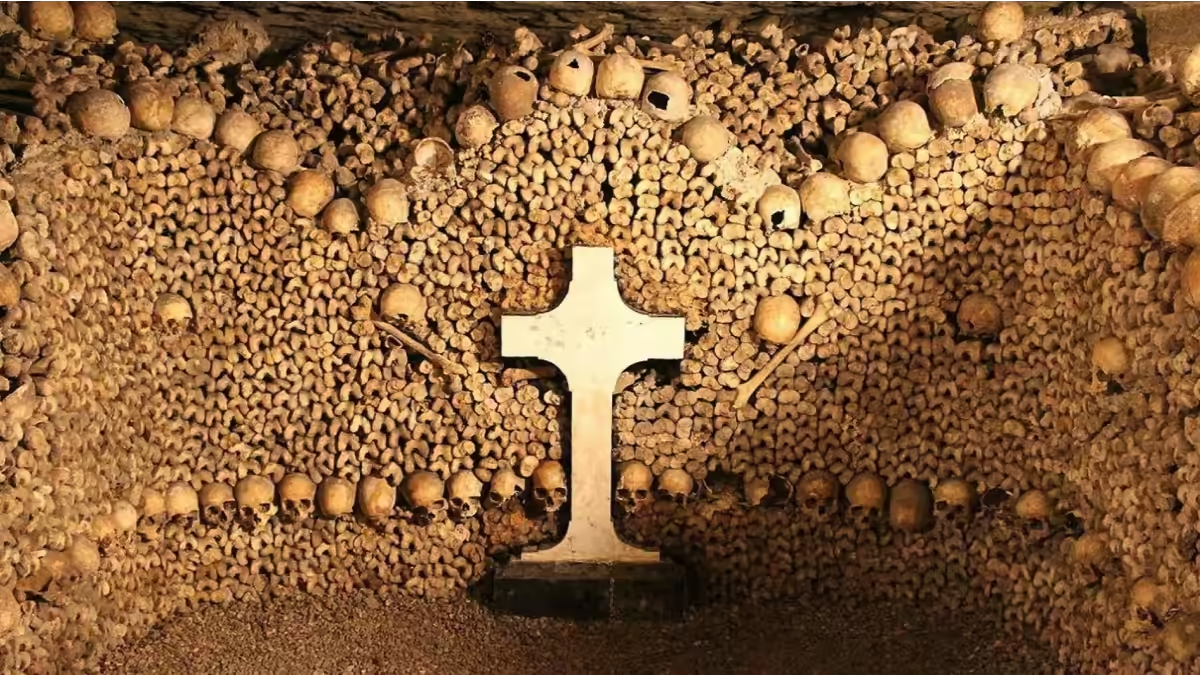
The Paris Catacombs closed for a major safety and preservation renovation, with works from 2023 and a final closure from late 2025, before reopening on 8 April 2026. Changes include a new visitor route, a new four-language immersive audio guide narrated in the voice of Héricart de Thury, upgraded exhibition design, and new climate control, lighting, fire-safety and accessibility systems. For today’s visitor, the experience is more structured but the fundamentals — the depth, the steps, the cold — are unchanged.
If you last visited the Paris Catacombs before 2023, or you’ve been holding off because you heard the site was closed, this is the guide to read. The Catacombs went through the most significant overhaul in decades, driven by the fragility of a 200-year-old ossuary cut into working quarries, and reopened on 8 April 2026 with a noticeably different visitor experience.
This guide sets out why the closure happened, what work was actually done, and what it means for anyone booking a visit now. For the older backstory of how the ossuary came to exist at all, see our history of the Paris Catacombs.
Why Did the Paris Catacombs Close?
The Catacombs closed because the site is fragile: an 18th-century ossuary carved into limestone quarries, exposed daily to the humidity, heat and carbon dioxide of visitors, with ageing lighting, fire-safety and climate systems beneath it all. Works began in 2023 on a rolling basis, with the site fully closed from late 2025 to complete the final stages before reopening in April 2026.
The bones, the carved inscriptions and the quarry walls themselves are all archaeologically and geologically sensitive, and none of it can simply be replaced if it’s damaged. Rather than patch around visitors indefinitely, the operator scheduled a final, focused closure to finish the works safely and properly, rather than stringing them out over years of partial disruption.
When Did the Catacombs Reopen?
The Paris Catacombs reopened to the public on 8 April 2026, after the final phase of closure that began in late 2025. Early bookings in the weeks after reopening were in high demand, partly out of curiosity about the new route and partly because of the backlog from the closure itself. If you’re planning a visit now, our guide to opening hours has the current schedule, and booking ahead remains essential.
What Changed in the 2026 Renovation
The renovation delivered a new visitor route, a new immersive audio guide in four languages narrated in the voice of Héricart de Thury, and upgraded exhibition design with educational displays, short films and temporary exhibitions along the galleries. Behind the scenes, new air-handling and climate control now monitor temperature, CO2 and humidity, alongside a redesigned lighting system and modernised fire-safety and security. Accessibility also improved for visitors with visual and hearing impairments, though the stair-only route still cannot take wheelchairs.
Renovation at a Glance
| Area | Before 2026 | After April 2026 |
|---|---|---|
| Visitor route | Original single route | New route through the galleries |
| Audio guide | Standard narration | Immersive four-language guide, voiced as Héricart de Thury |
| Exhibitions | Minimal in-gallery signage | Educational displays, short films, temporary exhibitions |
| Climate | Limited monitoring | New air-handling with temperature, CO2 and humidity control |
| Lighting | Older fixtures | Redesigned lighting system |
| Safety systems | Ageing fire and security infrastructure | Modernised fire-safety and security systems |
| Accessibility | Limited support | Improved support for visual and hearing impairments (still no wheelchair access) |
A New Route and Audio Guide
The most obvious change for visitors is the route itself, redesigned to manage flow through the galleries more comfortably while still ending at the ossuary that is the heart of the visit. Paired with it is a new audio guide, offered in four languages and narrated in the voice of Héricart de Thury, the engineer who arranged the ossuary in 1809 — a device that ties the storytelling directly to the history of the site rather than treating it as a generic commentary track.
Exhibition Design and Displays
Along the galleries, new educational displays and short films now sit alongside the original inscriptions and carved features, giving context that the tunnels never had room to explain on their own. The site has also introduced temporary exhibitions, meaning the experience can vary slightly between visits rather than being entirely fixed. None of this changes the ossuary itself, which remains as it was arranged in the 19th century.
Climate Control, Lighting and Safety
Less visible but arguably more important is the infrastructure work: a new air-handling system that actively monitors and manages temperature, CO2 levels and humidity, which matters both for visitor comfort in a sealed underground space and for the long-term preservation of the bones and stonework. A redesigned lighting system improves visibility along the route, and fire-safety and security systems throughout the site have been modernised to current standards.
Accessibility Improvements
The renovation also improved provision for visitors with visual and hearing impairments, including elements of the new audio guide and displays designed with accessibility in mind. One thing the works could not change is the physical route itself: it remains stairs-only, with 131 steps down and 112 up and no lift, so the Catacombs still cannot accommodate wheelchair users. Our guide to accessibility has the full picture for visitors planning around a mobility condition.
What It Means for Visitors Today
In practice, the renovation makes for a more structured visit than before, with clearer storytelling and a more comfortable underground environment, but the core experience — the depth, the 14°C chill, the walk past walls of bone — is unchanged in substance. Booking has, if anything, become more important: timed slots are still released only a week ahead and the post-reopening interest has kept demand high. If you’re weighing up whether the visit is for you at all, see our honest take on whether the Catacombs are worth visiting.
Frequently Asked Questions
Why did the Paris Catacombs close for renovation?
The site closed because it is genuinely fragile — an 18th-century ossuary cut into working limestone quarries, with ageing climate, lighting and safety systems beneath heavy visitor footfall. Rather than work around visitors indefinitely, the operator scheduled works from 2023 with a final, focused closure from late 2025 to finish the most disruptive stages properly and protect the bones and stonework for the long term.
When did the Paris Catacombs reopen after the renovation?
The Catacombs reopened on 8 April 2026, following a final closure period that began in late 2025. Demand in the weeks after reopening was high, so booking a timed slot well ahead is still the safest approach. Check current opening hours before you plan your trip.
What exactly changed in the 2026 renovation?
The main changes are a new visitor route, a new four-language immersive audio guide narrated in the voice of Héricart de Thury, upgraded exhibition design with educational displays and short films, new climate control monitoring temperature, CO2 and humidity, redesigned lighting, modernised fire-safety and security, and improved accessibility for visitors with visual and hearing impairments.
Is the ossuary itself different after the renovation?
No. The bones and their arrangement into walls and patterns, as organised by Héricart de Thury from 1809, have not been altered. What has changed is how the ossuary is presented and preserved: better climate control, lighting and storytelling around it, not the historic arrangement itself. See our guide to the ossuary for what you’ll actually see.
Is the new audio guide included in the ticket price?
Yes, the standard entry ticket includes the audio guide, now offered in the new four-language immersive format. It’s the main way most visitors get context for what they’re seeing, since the galleries themselves carry limited signage beyond the new educational displays introduced in the renovation.
Did the renovation make the Paris Catacombs wheelchair accessible?
No. The route remains stairs-only, with 131 steps down and 112 up and no lift, so wheelchair users still cannot visit the underground galleries. The renovation did improve accessibility for visitors with visual and hearing impairments through the new audio guide and displays. See our full accessibility guide for what support is available.
Do I need to book further ahead because of the renovation?
Booking ahead was already essential before the renovation, and reopening interest has kept demand high since. Official tickets release only seven days ahead and sell out quickly, so treat booking as early as your travel dates allow as the default, not an optional extra.
Is the visit different in length or difficulty after the renovation?
The physical demands are unchanged: about an hour underground, a 1.5km route, 131 steps down and 112 up, and a constant 14°C. The new route and displays add context along the way rather than extending the walk significantly. It remains unsuitable for very young children or anyone with mobility, respiratory or heart conditions.
